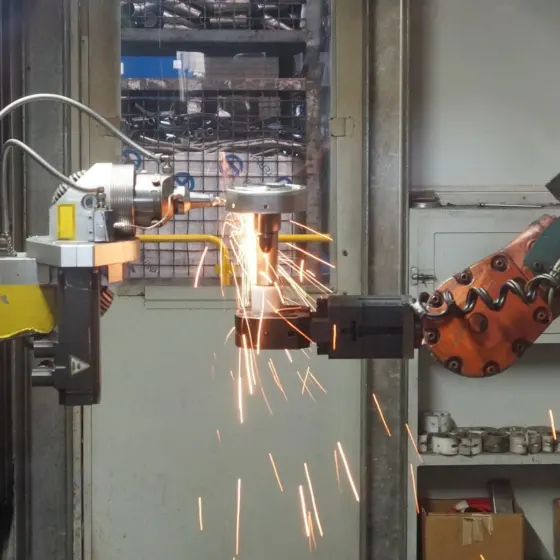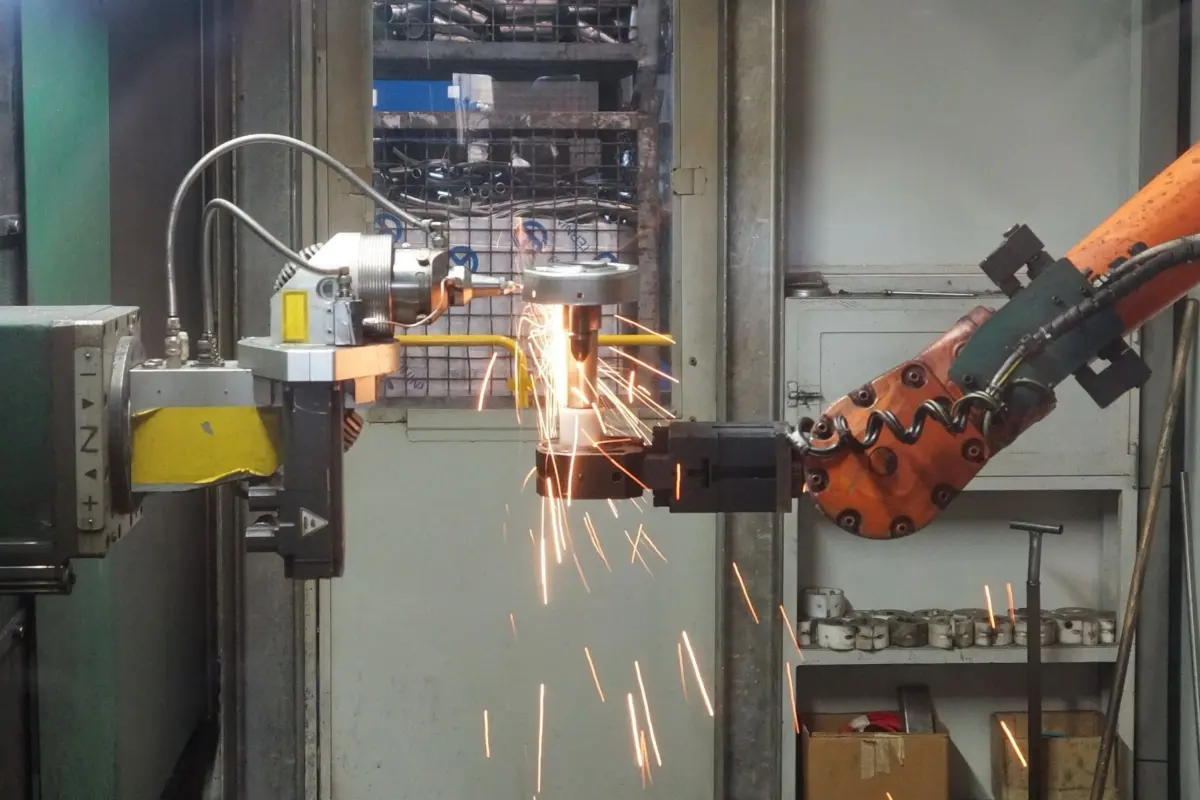
Types of industrial robots are sorted mainly by joint structure: articulated, SCARA, delta, Cartesian, cylindrical and collaborative. Choose the type whose motion matches your task, then confirm payload, safety requirements and budget.
This guide compares each class by what it does well and where it fits. For the wider picture of machines beyond the factory floor, see our overview of types of robots, or browse more in Robotics.
How joint structure sorts industrial robots
The International Federation of Robotics (IFR) uses the ISO 8373:2021 definition of an industrial robot: a machine programmable in three or more axes. Within that definition, the classes differ in how their joints are arranged. Rotary joints swing, prismatic joints slide, and a closed-loop arm links several arms to one tool. The arrangement decides which paths the tool can follow, so structure should be settled before you compare brands or payload figures.
| Type | Defining structure | Typical use | Planning use |
|---|---|---|---|
| Articulated | Three or more rotary joints | Assembly, welding, material handling | Default choice when parts must be reached from varied angles |
| SCARA | Two parallel rotary joints giving compliance in a selected plane | Electronics assembly and pick-and-place | Suits small parts handled in one plane |
| Delta (parallel) | Arms whose links form a closed loop | Lightweight, high-speed jobs such as packaging and sorting | Suits fast handling of light items from above a conveyor |
| Cartesian | Three prismatic joints forming X, Y and Z axes | Tasks laid out along straight lines | Suits layouts that map onto a rectangular work area |
| Cylindrical | At least one rotary and at least one prismatic joint | Cells where a turn plus a slide covers the task | Check the reach pattern against your layout before shortlisting |
Structures follow IFR’s classification of industrial robots, and the application notes come from a vendor guide to industrial robot types.
Collaborative robots are not a joint structure. They are a safety category, covered in their own section below.
Articulated robots: the general-purpose arm
Articulated robots are the most common choice when a task is varied or the part must be approached from several directions. IFR defines them as manipulators with three or more rotary joints, which gives the arm a human-like reach. A vendor guide describes them as well adapted to assembly, welding and material handling. IFR’s wider list of typical industrial robot work adds parts welding and cutting, flexible assembly, packaging and palletizing.
Which industrial robot type suits assembly?
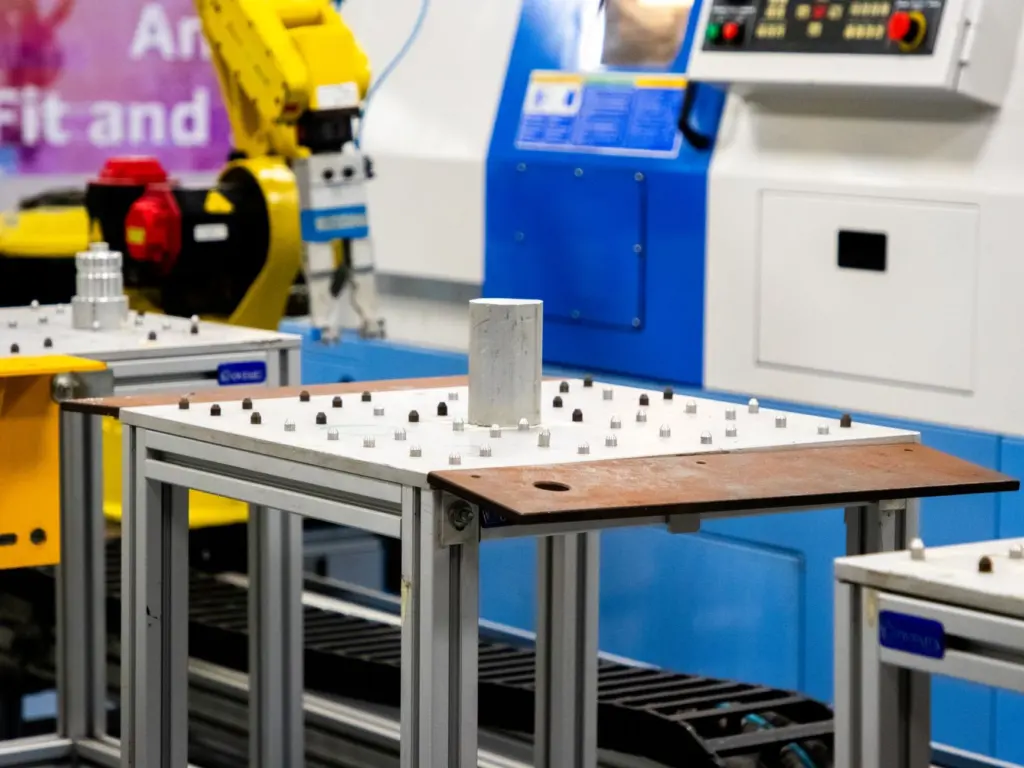
It depends on the part and the motion. For flexible assembly where parts arrive in different orientations or the product mix changes, an articulated arm is the safer starting point. For small electronic parts placed in a single plane, a SCARA robot is the more specialised fit, as the next section explains. Cartesian robots can also serve assembly where the work follows straight lines, though the supplied guidance for them centres on their linear axes rather than a specific assembly niche.
SCARA and delta robots: how they differ
SCARA and delta robots both serve fast, repetitive handling, but their structures point them at different jobs. A SCARA robot has two parallel rotary joints that provide compliance in a selected plane. A vendor guide calls that combination a good match for electronics assembly and pick-and-place. The compliance in one plane is the useful property: it helps when a part must seat into a fixture or board without the arm fighting the fit.
A delta robot is a parallel design whose arms have links forming a closed loop structure. The same vendor guide says delta robots handle lightweight jobs at very high speed, with packaging and sorting as typical uses.
- Pick SCARA when the task is placing or inserting small parts at a fixed station and the motion is mostly horizontal.
- Pick delta when light items flow past on a conveyor and sorting or packing speed is the priority.
- Look elsewhere when the part is heavy or must be approached from varied angles; an articulated arm then becomes the more realistic option.
Cartesian and cylindrical robots: straight-line and turn-and-slide motion
Cartesian robots suit work that fits a rectangular grid. IFR describes the type as a manipulator with three prismatic joints whose axes form a Cartesian coordinate system, and a vendor guide puts it simply: these robots move along three linear axes (X, Y and Z). Because every move is a straight line along a known axis, the motion is easy to picture and to lay out, which makes the type a natural fit when the workpiece sits on a flat table or bed.
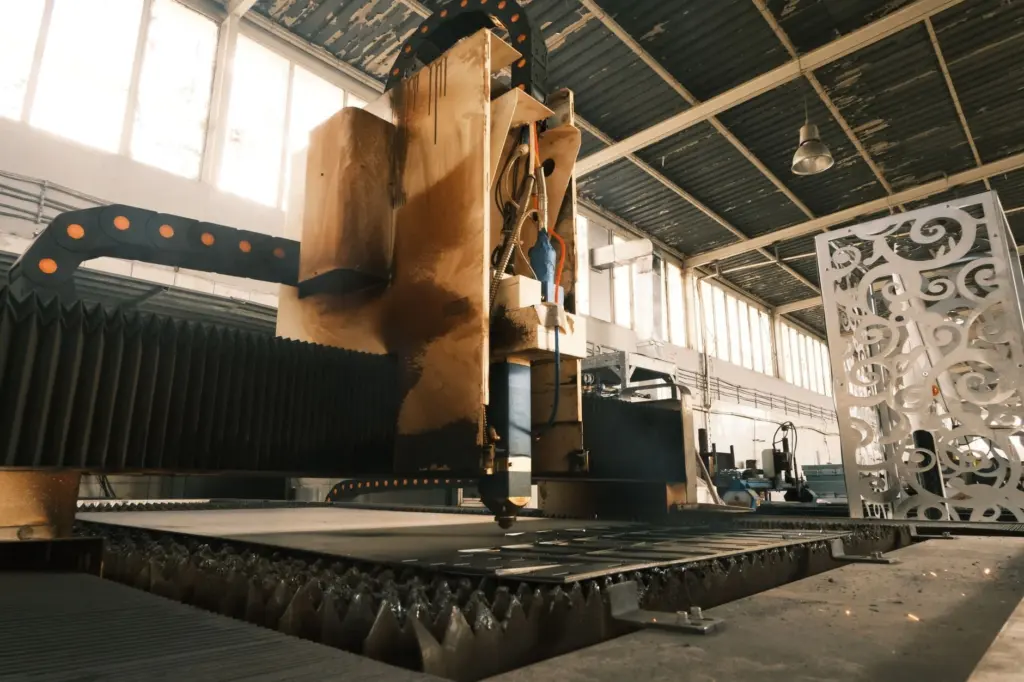
Cylindrical robots combine the two motion kinds. IFR defines them as manipulators with at least one rotary joint and at least one prismatic joint. Treat the type as a layout question: if a turn plus a slide reaches every point your process needs, it can be a simple answer; if the part positions are scattered, an articulated arm is more forgiving.
Collaborative robots: a safety category, not a shape
Collaborative robots, or cobots, are defined by how they behave around people. IFR reports that newly deployed collaborative robots grew by 31% to almost 55 thousand units in 2022, which was 9.9% of all industrial robots installed that year. Cobots are therefore growing quickly but remain a minority of installations.
IFR links the cobot category to ISO 10218-1, which specifies requirements for inherently safe design. The harm-limiting features it lists include lightweight materials, rounded contours, padding and force and speed sensors. A vendor guide adds that cobots have built-in sensors to detect when a human is nearby.
The practical case for a cobot is often about the cell, not the arm. IFR notes that lockout in traditional separate-workspace robot cells can cost thousands of dollars per minute of machine downtime. If operators must step into the work area often, a cobot’s contact-limiting design can reduce that cost. If the task is a fast, repetitive cycle with no human involvement, a conventional robot in its own cell may remain the better match.
Choosing a type: a four-step sequence
- Describe the motion. Decide whether the task is straight-line, planar, from-above or multi-angle. This step alone removes most types.
- Match the structure. Map the motion to the table above: Cartesian for rectangular layouts, SCARA for planar placement, delta for fast light picking, articulated for varied approaches.
- Decide how people will share the space. If humans must work beside the robot, shortlist cobot designs and review the safety standard requirements before pricing.
- Price the shortlist. Compare complete cells, including tooling and guarding, because the arm is only part of what you buy.
Related reading
Industrial arms are one branch of a broader field. Heavy site machinery is covered in our guide to construction robots, while human-shaped machines raise a different set of design problems, explored in What Is Humanoid Robot Design? A Practical Guide To Building Human-Like Robots In 2026.
Frequently asked questions
What does an industrial robot cost?
A vendor guide says industrial robots can cost anything from $3,000 to over $100,000. The spread is wide, so settle on the type and task first, then request quotes for the whole cell.
Which safety standards apply to industrial robots?
IFR names ISO 10218-1, ISO 10218-2 and ISO/TS 15066 as the safety standards developed for the industrial robotics sector.
Does an industrial robot have to be fixed in place?
No. Under the definition IFR uses, an industrial robot can be fixed in place or fixed to a mobile platform.