A buyer asks a humanoid robot company for a machine that can do any job. The realistic answer: these firms sell a robot, its AI software and deployment support, and they start with narrow industrial tasks.
Humanoids are one branch of the wider types of robots, and their business looks different from selling a catalogue arm or gripper. The sections below correct the assumptions worth challenging before any purchase or pilot.
What a humanoid robot company sells
Misconception: the product is the robot body. The company pages show a bundle. Humanoid, a maker of the HMND 01 Alpha, positions its product as industrial-grade humanoid labour, ready to deploy, and says the robot runs a proprietary four-layer AI stack (KinetIQ) on NVIDIA compute. Agility Robotics pairs its Digit robot with Arc, a cloud platform that runs customer fleets, and describes a field-tested, three-step deployment process: solution setup, on-site validation and operational impact.
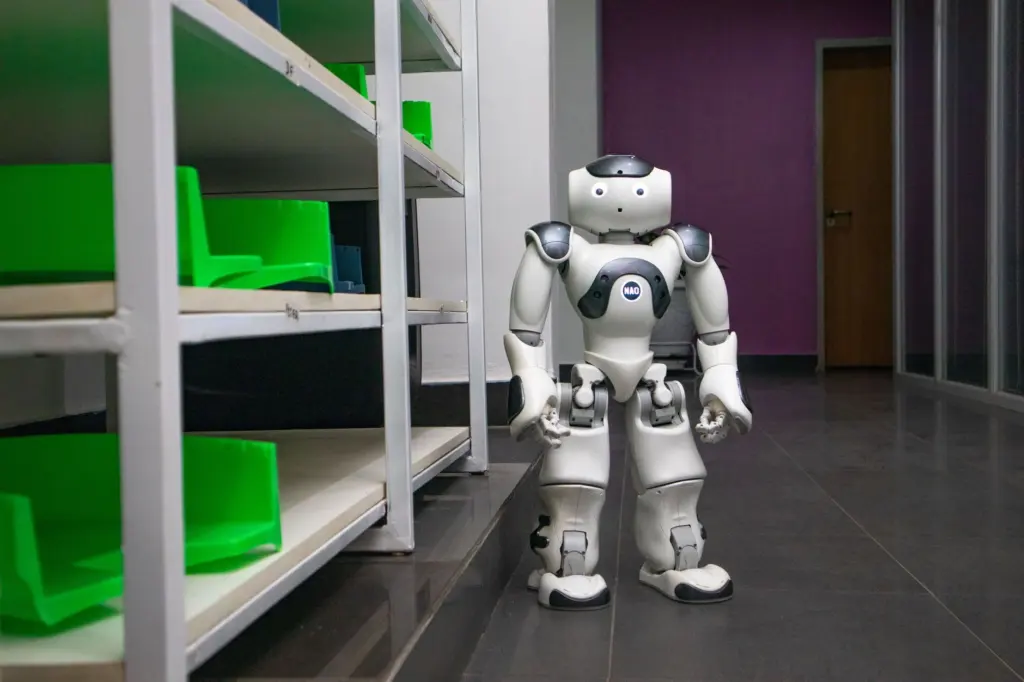
So a humanoid robot company does three jobs at once: it builds the machine, it supplies the intelligence that drives it, and it manages the rollout on the customer’s site. Apptronik describes its Apollo as designed to bring AI into the physical world, which fits the same pattern: the robot is the delivery vehicle for software that does physical work in human environments.
The table contrasts two makers on the same criteria. It is a way to see how different the offers are, not a ranking.
| Criterion | Humanoid (HMND 01 Alpha) | Agility Robotics (Digit) | Planning use |
|---|---|---|---|
| Stated environment | Industrial-grade labour | Built for industrial environments, with room for more | Both suit factory and logistics trials before anything else |
| Published capability | Up to 15 kg payload; 29 degrees of freedom excluding end effectors | 65,000 hours of real production experience | One leads with a spec sheet, the other with operating history; ask each for the other kind of evidence |
| Endurance | Up to four hours of uninterrupted operation | Fleet run through the Arc cloud platform | Check how charging and fleet management fit your shift pattern |
| AI and software | Four-layer KinetIQ stack on NVIDIA compute | Arc platform for fleets | Software is part of the purchase, so ask about updates and monitoring |
| Deployment evidence | Schaeffler deal headline; Siemens case study with NVIDIA; automotive logistics proof of concept with SAP and Martur Fompak | AGCO pilot at its Hesston, Kansas facility, dated Oct 20, 2026 | Separate signed deals and pilots from robots already in routine service |
Figures come from the makers’ own pages at Humanoid and Agility Robotics, so they are company claims rather than independent test results.
Where humanoids work today
Misconception: humanoids are mainly home helpers. Household work is a stated goal for some makers. Figure AI describes Figure 03 as a general purpose humanoid robot for every day and says the robot handles household tasks the way a person would. The deployment announcements in the other company materials, though, are industrial. Agility describes Digit as built for industrial environments, and Apptronik says Apollo is built for meaningful work in manufacturing, warehousing and logistics today.
The humanlike form earns its place where a workplace was designed around people: shelving, totes, tools and aisles. The robot adapts to the site rather than the site being rebuilt around the robot.
Use cases named by the makers
- Manufacturing and line-side work. Apptronik lists material handling, line-side tasks, inspection and repetitive workflows for Apollo. Humanoid points to a case study on deploying humanoids in industrial operations with NVIDIA, and to a deal headline with Schaeffler to deploy thousands of robots.
- Automotive logistics. Humanoid reports a completed proof of concept for automotive manufacturing logistics with SAP and Martur Fompak.
- Warehouse and fulfilment. Apptronik describes Apollo as designed to help pick, pack and move goods, with the aim of reducing repetitive strain.
- Retail back of house. Apollo is pitched at inventory, replenishment and back-of-house tasks.
- Agricultural equipment manufacturing. Agility announced a humanoid pilot with AGCO at its Hesston, Kansas facility on Oct 20, 2026.
- Household tasks. Figure positions its robot for everyday home use, which is the least evidenced of these markets in the company materials.
A humanoid is not automatically the right tool for these jobs. Where a task is a fixed pick-and-place station, compare the types of robot arms first. For handling boxes and flat parcels, the end effector often decides the result, which is the territory of Vacuum Gripper Robots: The Practical Guide To Picking, Using, And Integrating Them In 2026.
Hardware, software and fleet tools
Misconception: a humanoid maker is a hardware company. Hardware is the visible part, and the makers’ own descriptions put equal weight on the software layer. Humanoid’s four-layer stack and Agility’s Arc platform both sit above the mechanics, and both exist so that robots keep improving and stay manageable after delivery.

The practical consequence is that a purchase is a relationship. A buyer is choosing a vendor’s software roadmap and support model as much as a set of joints, so the questions to ask include how fleets are monitored, how updates reach the robots and who validates the robot on site. Agility’s three-step process, with validation on the customer’s site before operational impact, shows that deployment engineering is a product in itself.
Who the leading makers are
No single ranking settles who leads. A humanoid robot directory counts 53 companies that qualify because each has at least one published humanoid robot record, which shows how wide the field is but says nothing about which firms ship robots in volume.
The makers with the clearest published deployment material in this review are:
- Agility Robotics. Digit, with the Arc fleet platform and a stated 65,000 hours of production experience, plus the AGCO pilot.
- Apptronik. Apollo, with named use cases across manufacturing, retail and warehousing, and a choice between bipedal and wheeled mobility.
- Humanoid. The HMND 01 Alpha, with a published payload and runtime, and named industrial partners.
- Figure AI. Figure 03, aimed at general purpose, everyday use including household tasks.
Choose between them on the task and the evidence. A factory team with a defined logistics step should favour makers showing industrial pilots. A buyer who wants a general-purpose robot for varied tasks should treat that positioning as an ambition to test in a trial, not a delivered capability.
Judging a maker’s claims
- Separate deals from deployments. A headline about deploying thousands of robots describes an agreement. A pilot, like the AGCO one, is a validation step. Ask what the pilot must achieve before a wider rollout.
- Read ceilings as ceilings. The 15 kg figure is stated as what the robot handles up to, so size the real task load below it and ask how precision holds at the edge of that range.
- Plan around runtime. Up to four hours of uninterrupted operation means a longer shift needs a charging or swapping plan, and that plan is part of the cost of the workflow.
- Treat operating hours as company-reported maturity. A figure such as 65,000 production hours signals experience, but it does not guarantee performance on your task.
- Match the robot to the job. If the work is repetitive and fixed in place, a simpler machine may do it with less complexity than a humanoid.
Frequently asked questions
| Question | Answer |
|---|---|
| Does a humanoid robot always walk on legs? | No. Apptronik says Apollo comes with both bipedal and wheeled mobility options so it can adapt to different environments. |
| What does Agility Robotics’ deployment process involve? | It lists three steps: solution setup, on-site validation and operational impact. |
| Where is Digit built? | Agility says Digit is assembled by its own team in Salem, OR. |
| Does a supplier deal headline mean robots are already working in a plant? | Not necessarily. Humanoid’s Schaeffler headline announces a deal to deploy thousands of robots, which is an agreement about future deployment, so ask for the rollout schedule and acceptance criteria. |