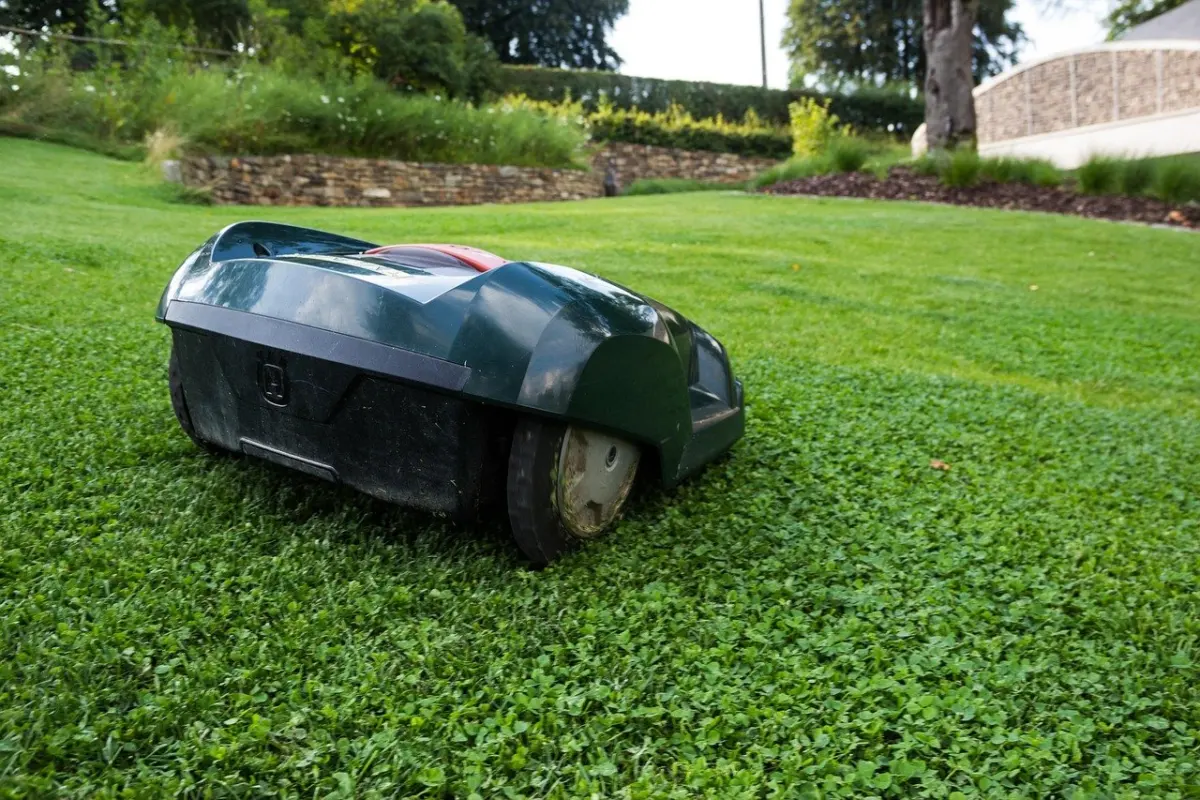
How does a robot lawn mower work? Small blades trim a little grass at a time, a boundary wire or GPS keeps the mower on the lawn, and it returns to its charging station to recharge when the battery runs low.
The indoor counterpart follows a similar sense-and-dock routine, and How Robot Vacuums Work: Inside The Sensors, Brushes, And Algorithms — A 2026 Guide shows where the two machines differ. The sections below follow the mower’s working day in order: cutting, staying inside the lawn, docking, then the limits worth planning around.
Cutting system: blades, height and mulching
A robot mower cuts by taking off very little grass on every pass. That is the opposite of a push mower, which removes a large amount in one weekly session. The design choice drives everything else: the machine has to run often, so it needs to navigate and recharge without help.
Blade action
Husqvarna describes its Automower as micro-mulching, cutting just a few millimeters at a time. Ecovacs gives the same picture in general terms: small, high-speed rotating blades cut grass a little at a time. Because each cut is so small, the clippings are short, which suits a mower that visits the lawn repeatedly instead of once a week.
Cut height and speed
Height is a setting rather than a physical swap of the deck. Ecovacs says its GOAT mowers let you adjust cutting height between 1.2 to 3.6 inches, and that the GOAT A3000 LiDAR uses a dual-blade disc that cuts at 2.3 feet per second. Those figures belong to that model, so read the specification of any mower you are considering before assuming the same range.
Staying inside the lawn: boundary systems
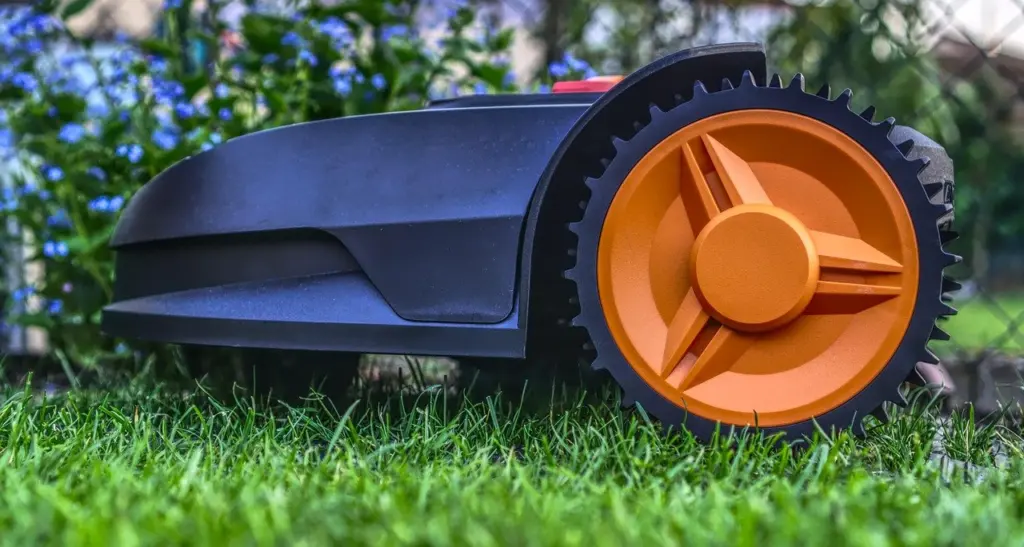
A robot mower needs a defined edge, and there are two broad ways to give it one: a physical wire or satellite positioning. Husqvarna says the Automower uses three methods to navigate home: a guide wire, a boundary wire and onboard GPS. Which one suits you depends mainly on how much open sky your lawn has and how willing you are to lay wire.
| Method | How it works | Planning use |
|---|---|---|
| Boundary wire | Placed or buried around the lawn edge and any obstacles | Reliable choice where satellite coverage is poor, but it takes installation effort |
| Guide wire | One of three ways the Automower finds its way home | Helps the mower reach the dock from distant parts of the lawn |
| GPS / RTK positioning | Select Automower models use GPS; RTK systems can pinpoint location within a few centimeters | Suits open lawns; accuracy may drop under dense tree cover or next to large buildings |
| Wire-free EPOS (RTK-GNSS) | Virtual boundary set by satellite positioning | Falls back to a buried wire where satellite coverage is poor |
Figures and conditions come from Husqvarna’s explanation of how the Automower works and LawnStarter’s robotic mower guide.
Boundary wire
The wire is the simplest mechanism to understand. Ecovacs notes that boundary wires are installed by hand along the lawn edges and emit a magnetic field that the mower detects. When the mower senses that field it turns back, so the wire acts as an invisible fence. Husqvarna adds that the wire goes around obstacles as well as the lawn edge, which is how flower beds and ponds are kept out of the mowing area.
GPS and RTK positioning
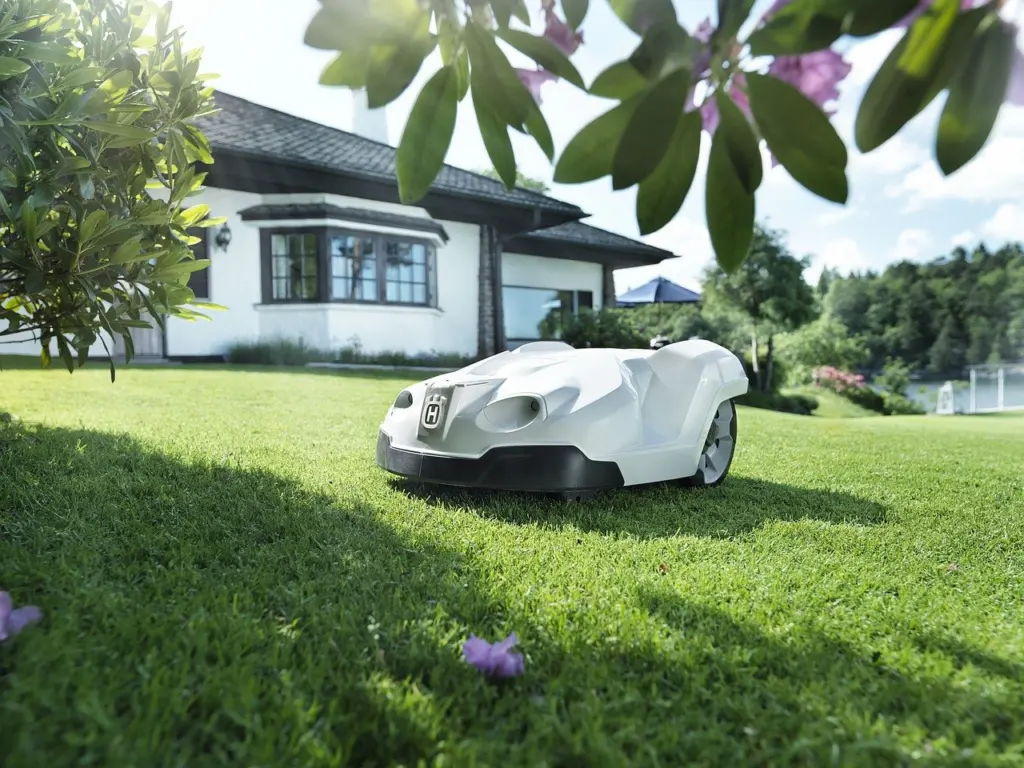
Wire-free mowers locate themselves instead of detecting a signal at the edge. CNET’s testing included the Eufy E15, which uses GPS and vision systems to navigate without a boundary wire. The trade-off is setup of a different kind: CNET reports that one RTK beacon was damaged when an animal chewed through its wire, and the repair meant a 70-minute trip. Choose positioning if you dislike trenching wire, but allow for hardware outdoors that can still fail.
Obstacles
The boundary handles the edges; contact handling covers everything inside. Husqvarna says that if an Automower encounters an object it will stop, reverse and go in another direction. When the mower is lifted, its blades shut off automatically and immediately.
Docking and recharging
The charging station is the mower’s home base, and the mower finds it without prompting. Husqvarna says the Automower navigates to the charging station automatically when its battery runs low, either via a signal or by following the wires. This is why the guide wire and boundary wire matter even to owners who care little about the boundary: they also form the route home.
Dock location is therefore a navigation decision as well as a convenience. The placement guidance in the FAQ below covers clearance and connectivity, and it is worth settling before you run any wire.
Slopes and terrain
Slope handling varies far more between models than most other specifications, so treat any single figure as a ceiling for a particular machine. Husqvarna says standard models can typically handle slopes of 20% to 40%, while specialized all-wheel-drive (AWD) models can manage inclines up to 70% (approximately 35°). Ecovacs states that its GOAT A3000 LiDAR can climb slopes up to 27°. LawnStarter’s view is that many models struggle on grades steeper than 70% (35 degrees).
- Gentle to moderate lawns: a standard model rated for 20% to 40% is the sensible match, so check your steepest section against that rating rather than the average slope.
- Steep banks: only AWD-class machines are described as reaching 70%, so a two-wheel-drive model is the wrong tool there.
- Mixed rating units: manufacturers quote percentages and degrees interchangeably, so convert to the same unit before comparing models.
Sources for these ratings are Husqvarna and Ecovacs, so they describe those brands’ own models rather than every robot mower.
Blade wear and replacement
Blades are the part that needs the most regular attention. Husqvarna recommends replacing the small, razor-sharp blades every 1 to 2 months, depending on lawn size and grass type. A bigger lawn or tougher grass means the earlier end of that range.
CNET’s reviewer found a reason not to stretch it: because the blades are small razor blades, they may start to get dull more quickly than push mower blades, and after about two months in Chicago most of the blades were starting to show signs of rust. Treat blades as a consumable: keep spares on hand and swap them on a schedule instead of waiting for ragged cuts.
Where to go next
Once the mechanics are clear, the decision becomes about matching boundary type, slope rating and blade upkeep to your own yard. For a wider look at household robots, including the best robot vacuum options, start at the hub, or browse more in Consumer Technology. If low noise is what you value indoors, The Quiet Robot Vacuum: How To Pick A Nearly Silent Cleaner For Peaceful Homes (2026 Guide) applies that same priority.
Frequently asked questions
Does a robot mower work in the rain?
Husqvarna says the Automower is designed to work in the rain, and its weather timer adjusts the mowing schedule to grass growth.
Where should the charging station go?
Ecovacs advises a flat, open area with a strong Wi-Fi signal and power supply, at least 6.56 feet away from buildings and trees. CNET reports that mower companies discourage placing the mower within 7 feet of a building or under a tree.
Does a robot mower leave any grass uncut?
Yes. LawnStarter notes that it leaves a thin strip of uncut grass along fences and walls, so plan a little trimming along those edges.
Is a robot mower noisy?
It is much quieter than a gas push mower. LawnStarter puts typical robot mower noise at around 65 decibels, compared with roughly 100 decibels for a gas push mower.