
| Degree route | What it builds | Planning use |
|---|---|---|
| Robotics engineering bachelor’s | The most direct path into the field, with robotics-specific coursework throughout | Choose it if a programme is within reach. It needs the least self-assembly of skills. |
| Mechanical engineering | The physical body and actuation; many courses offer a mechatronics or robotics specialisation | Suits you if you want to design frames, joints and drive systems. Pick the specialisation where one exists. |
| Electrical engineering | Electronics, embedded systems, low-level programming and control theory | Suits you if circuits, firmware and control loops appeal. Add mechanical design through projects. |
| Computer science | Often includes robotic programming topics such as artificial intelligence and software design | Suits a software-first plan. Add hardware builds yourself, because the degree rarely supplies them alone. |
Route descriptions come from Robotiq’s guide to what to study for a robotics career and Udacity’s step-by-step career guide.
To learn how to become a robotics engineer, earn a bachelor’s degree in robotics or a related engineering or computer science field, then pair it with hands-on builds, programming in Python and C++, and ROS experience.
If you would rather test the craft before committing to a degree, our wider material on how to build a robot is the natural starting point, and more engineering guides sit alongside it.
Choosing a degree route
A bachelor’s degree is the typical entry route. AlmaBetter’s career guide lists robotics engineering, mechanical engineering, electrical engineering, computer science or a related field as acceptable starting points. You do not need a degree with “robotics” in its name, but you do need to plan around what your chosen degree leaves out.
The reason is structural. Robotics draws on three core disciplines: mechanics, electronics and computer science, as the Robotiq guide puts it. Any single-discipline degree covers one of them well and the others only partly. The practical consequence is that your electives, final-year project and side builds should deliberately cover the gaps.
What each route means for your first job
- Mechanical with a mechatronics focus. You arrive with strong physical design skills. Expect to spend extra time on microcontrollers and programming before software-heavy teams take you seriously.
- Electrical. Control theory and embedded systems are already in your toolbox, which suits roles near sensors, motor drivers and firmware. The mechanical side is the gap to close.
- Computer science. AI and software design transfer directly to perception and planning work. Hardware exposure is the weak spot, so choose labs and projects that put code onto real robots.
- Dedicated robotics degree. It spreads effort across all three disciplines from the start. The trade-off is availability: not every region or university offers one, which is why the related routes above remain sound.
Most engineering curricula also include design challenges and capstone projects in which students build and program robots, according to Udacity. When comparing programmes, treat the presence of those projects as a selection criterion alongside the degree title.
Hands-on projects, clubs and competitions
Practical experience is the part of the path you control most directly. Robotiq notes that many people in the field recommend extracurricular hands-on experience with robots throughout your education. A degree transcript shows you passed the theory; a working robot shows you can make the theory behave.
Competitions and clubs
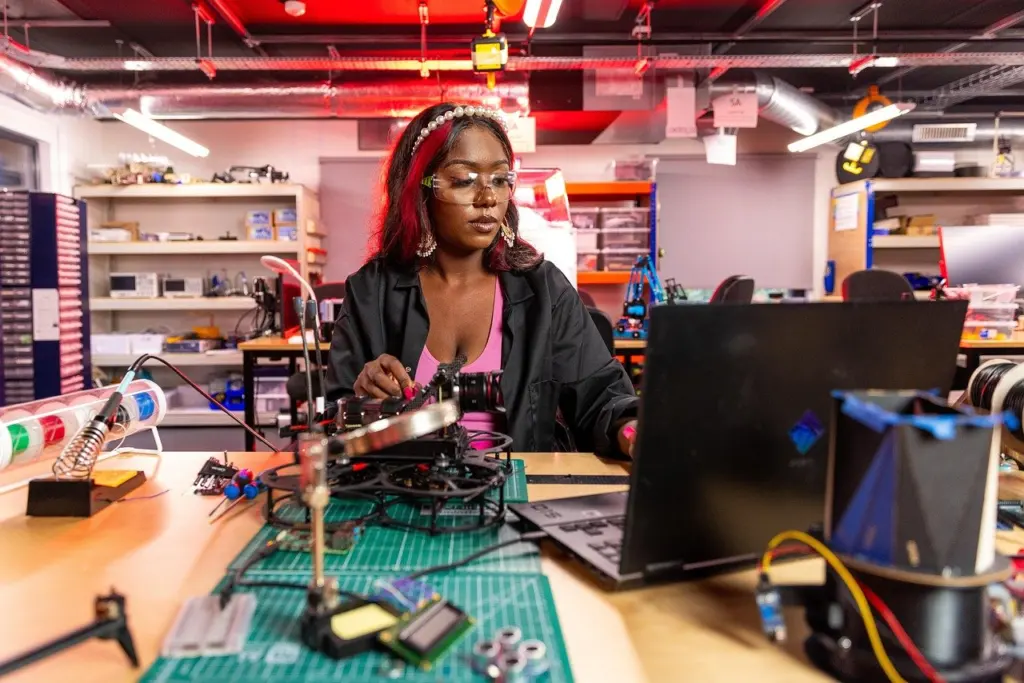
AlmaBetter recommends robotics competitions and clubs such as FIRST Robotics and RoboCup as places to apply classroom theory. Their main value is that they force you to integrate mechanics, electronics and software under a deadline. If your school or university has a team, joining it is a stronger move than another online course on the same topic.
Solo builds
When no team is available, start small and finish something. Our guide, How To Build A Robot For Beginners: A Simple Step‑By‑Step Guide For 2026, suits a first project. Extend it as your skills grow: add a microcontroller, then sensors, then software that makes decisions. Keep notes, code and photos of each stage, because those become the evidence you show employers later.
Skills checklist for robotics engineers
The skills below appear repeatedly across the career guides. Treat them as a checklist to tick off through coursework and projects, not as a prerequisite list to finish before you start building.
- Python and C++. Both appear in AlmaBetter’s list of commonly used robotics languages, and Udacity calls proficiency in Python, C/C++, Java and MATLAB critical for programming robot control systems and behaviours. Python and C++ are the two languages both guides name, so begin there.
- ROS. The Robot Operating System is an open-source framework for robotics development, and Udacity lists hands-on experience with it among the expected skills. Practise it on a real or simulated robot instead of reading about it.
- Mechanical systems and CAD. Udacity names familiarity with CAD tools such as AutoCAD and SolidWorks for designing robot structures, configurations and simulating mechanisms.
- Electronics and embedded systems. Embedded systems, microcontrollers and sensors form the building blocks of robots, per Udacity. Our guide to Types Of Sensors: The Essential Guide To Sensor Technologies In 2026 helps you choose which sensing hardware to learn first.
- Actuators and control systems. AlmaBetter lists mechanical systems, electronics, sensors, actuators and control systems as fundamental to robotics. Control theory is where electrical and software skills meet the moving hardware.
Notice how the list spans all three disciplines. A candidate who can write Python and C++, wire a microcontroller to a sensor and reason about a control loop covers more of the field than one who has deepened only a single area.
Salary expectations
AlmaBetter says robotics engineers often command competitive salaries because of the specialised nature of their skills. Pay varies by country, employer and specialisation, so compare current job listings and national statistics for the market where you plan to work before judging an offer. Salary also tends to follow the breadth you build, so the skills and projects above feed directly into your negotiating position.
An order of operations from student to first role
The steps overlap in practice, but this sequence avoids the most common wasted effort.
- Secure the mathematics. Robotiq calls mathematics a must for anyone preparing for this career.
- Pick a degree route from the table above, based on whether you lean toward hardware, electronics or software.
- Build alongside your coursework in a club or on solo projects, rather than waiting for the capstone.
- Learn Python, C++ and ROS on a working robot so each language is tied to behaviour you can see.
- Document your projects and apply to roles where mechanics, electronics and software overlap, since your builds demonstrate that mix.
Udacity frames the broader route as a five-step framework to landing a job in the industry, which echoes the idea of treating this as a staged plan rather than one big leap.
Frequently asked questions
What should I study before university?
Mathematics is the one subject Robotiq describes as a must. Pair it with any chance to tinker with electronics or programming, and join a school robotics club if one exists.
Is ROS a programming language?
No. Udacity describes the Robot Operating System as an open-source middleware designed for robotics development. You write your code in languages such as Python or C++ and use ROS to connect the pieces of a robot.
What does a dedicated robotics bachelor’s cover?
Udacity says a robotics engineering bachelor’s covers kinematics, dynamics, control theory and AI and machine learning. AlmaBetter adds robotics fundamentals and programming as typical topics in university robotics programmes.