| What the system does | Effect on results | Planning use |
|---|---|---|
| Learns from images paired with captions | Picks up statistical relationships between words and visual elements | Judge a tool by how well its learned associations fit your subject, not by a fixed library of pictures. |
| Runs a guided denoising process | The same prompt gives a different image each time | Generate several candidates and choose, rather than expecting an exact repeat. |
| Uses a text encoder to steer each step | Sets the ceiling on how well the system follows a detailed brief | For long, specific prompts, test prompt-following before comparing image polish. |
| Creates an image instead of retrieving one | Does not look up a matching photo | Treat output as a new illustration, not a record of a real scene. |
| Takes a few seconds per run | Generation is not instant | Allow a short wait for every attempt when you plan to iterate. |
| Mostly built on diffusion in 2026 | Most systems in use in 2026 are diffusion models | Start a tool comparison with diffusion-based options. |
The descriptions in this table follow the explainer on how AI image generation works and the AI image generator guide from Atelier AI Studios.
How does text to image AI work? It learns links between words and visual elements from captioned images, then builds a new image from noise while a text encoder steers each step toward the prompt.
Readers who want the broader field can start with the hub that answers how is ai used in robotics.
What the process means in practice
The practical consequences all follow from one design choice: a text-to-image system runs a guided denoising process rather than looking something up. Four habits follow from that.
Run-to-run variation
The SoftBlues explainer notes that a guided denoising run is why the same prompt gives a different image each time. A result you like is therefore one draw, not a setting you can recall on demand.
- Keep several candidates. Produce a handful of images from one prompt and pick the best instead of polishing a single result.
- Change the wording when one element keeps failing. If a re-run repeatedly misses the same detail, the issue is more likely how the prompt is interpreted than bad luck.
Prompt detail and the text encoder
According to SoftBlues, the text encoder, not the image part of the system, sets the ceiling on how well it follows a detailed brief. A tool can produce attractive pictures and still ignore half of a long prompt, so image polish alone is a poor guide to prompt-following.
- Short, loose prompts. Most tools will give you something usable, so choose on style and cost.
- Long, specific briefs. Test each candidate tool with your own detailed prompt before committing, because the encoder decides how much of that detail survives.
Created, not retrieved
Atelier AI Studios describes the model as not looking up a matching photo; it creates a new image from the prompt. The output is an illustration shaped by learned associations, so it should not be presented as evidence of a real place or event. Telling such images apart from photographs is a separate problem, covered in How Does AI Detection Work? A Clear, Practical Guide For 2026.
Which model family to look at
Diffusion is the sensible default. SoftBlues states that most systems in use in 2026 are diffusion models, and it says diffusion replaced generative adversarial networks for text-to-image work because it trains more reliably and takes direction better. That is a vendor judgement without benchmark figures, so read it as a general trend, not a measured gap.
- Diffusion-based tools. The best starting point for most readers, since they are what most current products use.
- Stable Diffusion and DALL-E. Dochipo describes both as using language processing and image generation techniques to interpret prompts, and Colocation America calls Stable Diffusion one of the most popular text-to-image generators. Popularity is a reason to find plenty of guidance, not proof of better results for your task.
- Autoregressive models. These predict the image piece by piece, and the SoftBlues comparison rates their text control as very strong on detailed briefs. They suit a reader whose main concern is following a long prompt, though that rating is the vendor’s own.
How models learn from captions
Text-to-image models are trained on datasets of images paired with their captions, as Colocation America explains. Atelier AI Studios puts the scale at hundreds of millions of image-text pairs, and Dochipo says generative AI analyses data on millions of images to learn associations. Both figures are vendor descriptions rather than audited counts.
What the model takes from these pairs is statistical. It learns relationships between words and visual elements, so a phrase becomes linked with the patterns that tend to appear in images captioned with it. It does not keep a catalogue of pictures to copy from. This is also why the caption side of the data matters: the words attached to images are the only route by which language gets connected to appearance.
The text encoder is the part that applies this at prompt time. It converts the typed prompt into a compact, meaningful representation that is passed to the image generator.
What a diffusion model is
A diffusion model is an image generator trained by destroying images and learning to repair them. The SoftBlues explainer describes training as taking real images and adding noise in small steps until nothing recognisable is left, then learning to undo each step. A model that has learned to reverse every small step has, in effect, learned what plausible images look like.
The same source adds that diffusion models work in a compressed representation of the image rather than on raw pixels. The practical benefit is that the model handles a compact version of the picture while it refines it, which is a design choice about where the work happens, not a change to what the model learns.
From prompt to image, step by step
Generation reverses the training process, with the prompt acting as a guide. The sequence below combines the descriptions from Colocation America and SoftBlues.
- Encode the prompt. The text encoder turns your words into a compact representation for the image generator.
- Start from noise. The model runs its learned process backwards from noise, not from a stored picture.
- Denoise in guided steps. At each step the text encoder steers the result toward the prompt, which is why wording changes the outcome.
- Stay in compressed form. The refinement happens in a compressed representation of the image rather than on raw pixels.
- Receive a new image. Each run ends with an image that differs from the previous run of the same prompt.

Because every step depends on the prompt, a vague prompt leaves the encoder little to steer with, while a detailed one tests the limit described earlier. That is the point to watch when results disappoint.
Generated images and robot vision
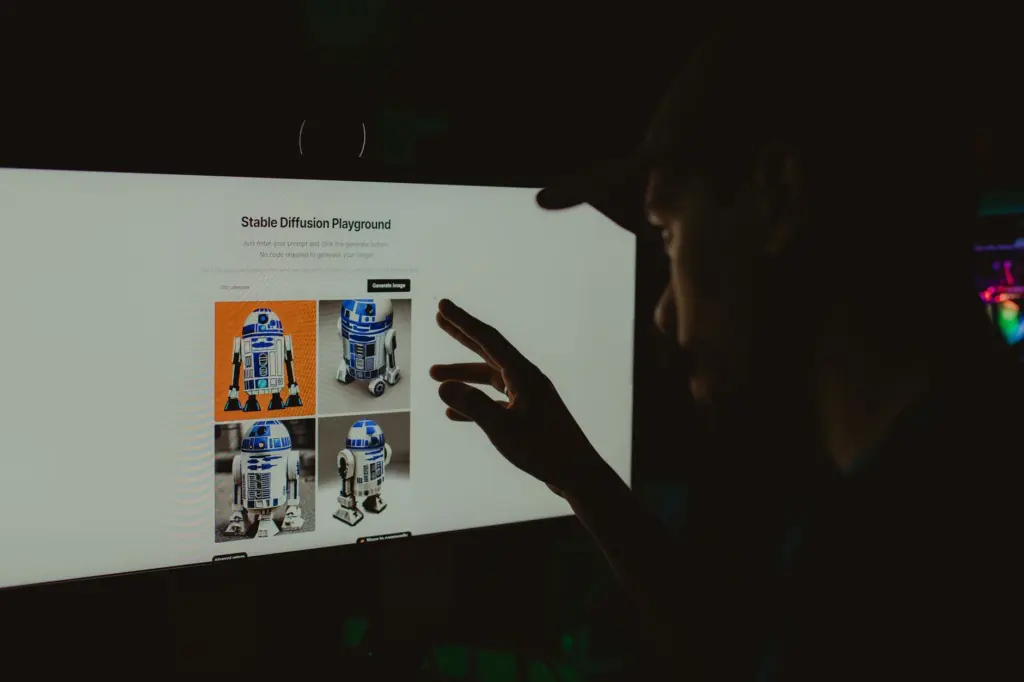
A generated image shows what a model’s learned associations suggest for a prompt. A robot’s camera feed is a recording of a physical scene. Keeping that distinction clear is the main judgement to bring to any claim that generated pictures can stand in for real camera views: the image generator was built to produce plausible pictures from words, not to report what is in front of a machine.
The wider question of how machines perceive and act in the physical world is the subject of what is embodied ai. More explainers are collected under artificial intelligence.
Frequently asked questions
What is a generative adversarial network?
It is an older image approach in which a generator is pitted against a discriminator, and the two compete. SoftBlues places its dominance at around 2017 to 2021, before diffusion took over text-to-image work.
Which text-to-image generators are commonly named?
A January 2023 article from Colocation America lists Stable Diffusion, DALL-E 2, MidJourney and Craiyon, and calls Stable Diffusion one of the most popular.
How long does one image take to generate?
SoftBlues describes generation as taking a few seconds rather than being instant, since the model works through a multi-step denoising run. The source gives no exact step count.