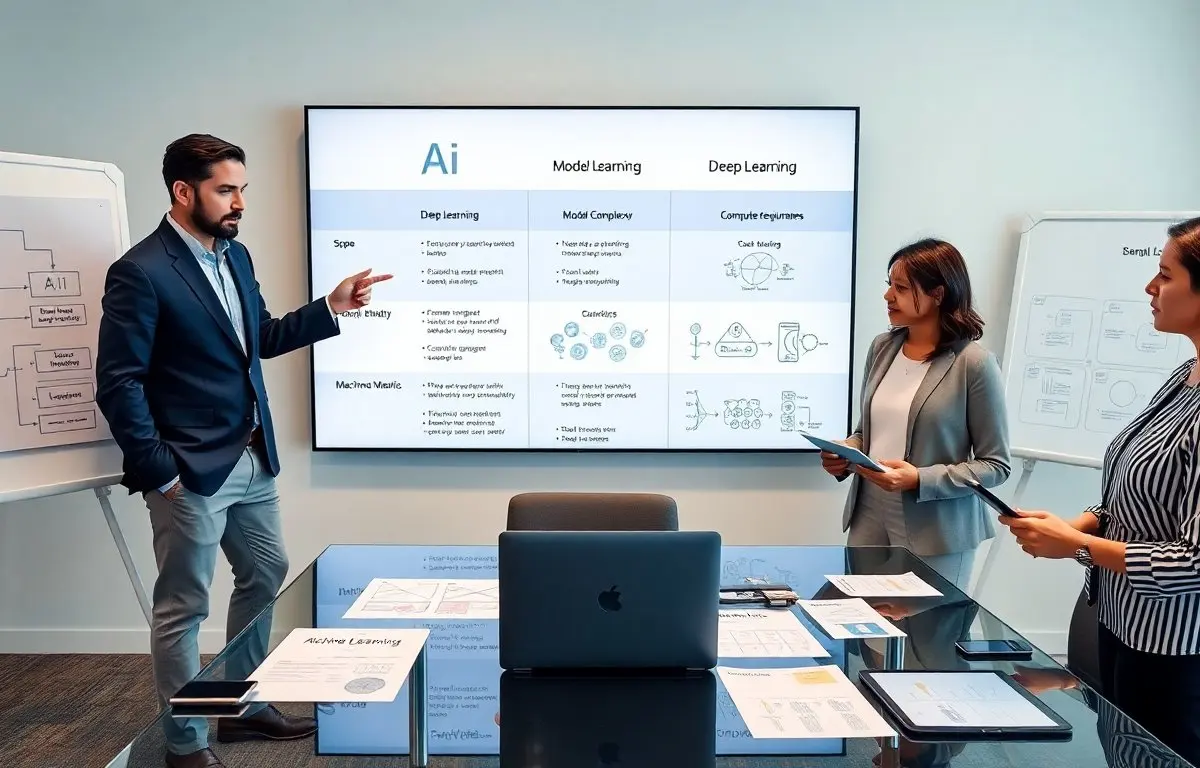
ai vs deep learning vs machine learning is a common question for project leads and students. They want clear differences and practical rules. This article explains each field, shows examples, and gives guidance for choosing. Sentences stay direct. Terms stay simple. The goal is clarity so readers can pick between AI, machine learning, and deep learning with confidence.
Key Takeaways
- Artificial Intelligence (AI) encompasses systems that mimic human judgment to perform tasks like fraud detection and voice assistance.
- Machine Learning (ML) is a subset of AI that enables systems to learn patterns from data without explicit programming, improving adaptive behaviors such as email filtering.
- Deep Learning (DL) is a specialized branch of ML using multi-layer neural networks, excelling in processing raw data like images and language with high data and compute demands.
- Choosing between AI, ML, and DL depends on available data, model complexity, compute resources, and the need for interpretability.
- For limited labeled data and simpler tasks, traditional machine learning is preferable; deep learning suits large datasets and complex tasks involving images, audio, or text.
- Balancing performance, inference cost, and regulatory requirements helps teams select the best approach, leveraging “ai vs deep learning vs machine learning” as a framework for decision-making.
What Is Artificial Intelligence? Scope, Goals, And Real-World Examples
Artificial intelligence describes systems that perform tasks that usually need human judgment. AI aims to sense data, reason about it, and act to reach goals. Companies use AI for search ranking, fraud detection, and voice assistants. In health care, AI helps flag abnormal scans and suggest diagnoses. In finance, AI scores risk and automates trading actions. AI can combine rules and learning. It can also use simple scripts or advanced models. AI’s scope covers planning, perception, language, and decision making. Readers should note that machine learning and deep learning sit under the AI umbrella.
AI projects vary widely in scope. A rules-based chatbot that follows a flowchart is AI even if it does not learn. A predictive maintenance system that uses statistical thresholds is also AI if it automates decisions. At the other end, systems that adapt from user behavior and refine their outputs over time use machine learning inside an AI solution. When planning an AI project, list the problem, the required autonomy level, and the expected inputs and outputs. This helps decide whether the solution will be rule-driven, learning-driven, or a hybrid.
Real-world adoption also depends on non-technical factors. Data governance, privacy, and domain expertise shape what AI can do in practice. Operational concerns — such as integration with existing software, latency requirements, and monitoring — determine feasibility. Clarifying these constraints early prevents chasing unnecessarily complex models when simpler AI approaches solve the business need more reliably.
What Is Machine Learning? Core Concepts And How It Fits Inside AI
Machine learning gives systems the ability to learn from data without explicit rules. It replaces handcrafted rules with models that map input to output. Teams train models on labeled or unlabeled datasets. Models then make predictions or group similar items. Machine learning improves many AI services by supplying adaptive behavior. It handles tasks like email filtering, demand forecasting, and recommendation. Teams pick features, choose algorithms, and validate models. Machine learning needs data, a model, and evaluation. It fits inside AI as the main method for learning patterns from data.
At a practical level, machine learning projects follow a common workflow: define the objective, gather and clean data, select features and algorithms, train and validate models, and deploy and monitor in production. Feature engineering — creating informative inputs from raw data — is often the most time-consuming step for traditional ML. Classic algorithms include linear models, decision trees, ensemble methods, and clustering techniques. Each has trade-offs in performance, interpretability, and training cost.
Evaluation is central to machine learning. Teams use validation sets, cross-validation, and relevant metrics (accuracy, precision, recall, AUC, RMSE, etc.) to compare approaches. Robust ML also includes processes for handling concept drift, label noise, and missing data. For many business problems with limited data and structured inputs (tabular data), these traditional ML techniques hit a strong accuracy/complexity sweet spot.
Types Of Machine Learning: Supervised, Unsupervised, And Reinforcement
Supervised learning trains models on labeled examples. It predicts outcomes such as price or class label. Unsupervised learning finds structure in unlabeled data. It finds clusters, detects anomalies, and reduces dimensions. Reinforcement learning trains agents that take actions to maximize reward. It suits games, robotics, and control problems. Each type needs different data and metrics. Supervised learning demands clear labels. Unsupervised learning needs domain knowledge to evaluate clusters. Reinforcement learning requires simulation or careful safety controls. Teams choose the type that matches the problem and the available data.
Choosing the right learning paradigm depends on business constraints. Supervised methods are the most widely applicable when labeled outcomes exist. Unsupervised approaches are useful for exploratory analysis, anomaly detection, and pretraining representations. Reinforcement learning is powerful when an agent must learn sequential decisions and when a reliable environment or simulator can provide feedback. Hybrid approaches are common: for example, unsupervised pretraining followed by supervised fine-tuning, or supervised models guiding reinforcement learning policies.
What Is Deep Learning? Neural Networks, Layers, And Modern Breakthroughs
Deep learning uses multi-layer neural networks to learn features directly from raw data. It stacks layers that transform inputs into higher-level representations. Modern deep models power image recognition, language models, and speech systems. Breakthroughs in architectures and compute made deep learning effective on large datasets. Engineers use convolutional networks for images and transformers for sequence data. Deep learning scales with data and compute. It often reduces the need for manual feature design. Practitioners still need careful tuning, regularization, and large labeled datasets for best results.
Key architectural ideas enable deep learning’s success. Convolutions exploit local patterns in images; recurrent and transformer blocks model temporal or sequential dependencies in text and audio. Pretraining on large, generic datasets followed by fine-tuning on a specific task is a practical pattern that delivers strong results with less labeled data than training from scratch. Transfer learning, data augmentation, and self-supervised objectives help teams get more value from limited annotations.
The compute and engineering investment is usually higher for deep learning. Training large models can require specialized hardware and long experiments. But deployment options range from optimized smaller models for edge devices to cloud-hosted inference for latency-tolerant services. Monitoring and guarding against overfitting, bias, and adversarial inputs are essential operational tasks for deep learning systems in production.
AI Vs ML Vs DL: Key Differences Summarized (Data, Models, And Compute)
AI covers any system that acts to meet goals. Machine learning gives AI the ability to learn from data. Deep learning is a subset of machine learning that uses deep neural networks. Data needs rise from AI (low) to ML (moderate) to DL (high). Model complexity and compute needs rise in the same order. Interpretability drops as complexity rises: rule-based AI is clear, many ML models are partly clear, deep models are least transparent. Development time and cost often increase from basic ML to deep learning. Teams should measure data volume, required accuracy, compute budget, and the need for model explanation before choosing.
To make comparisons actionable, consider these axes: data availability (labels and volume), problem type (tabular vs. unstructured), latency and throughput requirements, and regulatory constraints. For tabular business data with limited examples, classical ML often gives the best return. For visual, audio, or natural language tasks where patterns are complex and abundant data exists, deep learning typically outperforms alternatives. For prototyping, simpler models let teams iterate faster and surface hidden issues before committing to heavy infrastructure.
Operational concerns also separate the approaches. Deep models may require GPU or TPU resources for training and specialized runtimes for efficient inference. They can also change rapidly as models are retrained, so continuous evaluation and canary deployment strategies are common. Simpler ML models are easier to explain, debug, and version. In regulated industries, explainability and audit trails often tilt decisions toward simpler, more transparent approaches.
How To Choose Between Machine Learning And Deep Learning For Your Project
They should start with the data. If they have limited labeled data, they should try traditional machine learning first. If they have large labeled datasets and compute, they should consider deep learning. They should evaluate performance on a validation set and measure inference cost. They should prefer interpretable models when regulations require explanations. They should pick deep learning for tasks involving raw images, audio, or long text sequences. They should pick simpler models for tabular data and small datasets. They should prototype fast, measure results, and scale the approach that meets accuracy and cost targets. The phrase ai vs deep learning vs machine learning helps teams frame their options and pick the right starting point.
Practical decision steps: 1) Define success metrics tied to business outcomes. 2) Audit available data for volume, label quality, and representativeness. 3) Run quick baselines with simple models to establish a minimum viable performance. 4) If baselines fail and data is sufficient, experiment with deep learning architectures and transfer learning. 5) Factor in deployment constraints — latency, hardware, and monitoring needs — before committing to a full-scale solution.
Finally, plan for lifecycle management. Whatever approach you pick, include data pipelines for ongoing labeling, validation suites to detect drift, and tools for model explainability and fairness checks. Iteration and operational maturity often matter more than picking the theoretically optimal method up front. Using “ai vs deep learning vs machine learning” as a decision framework helps teams choose the approach that balances accuracy, cost, interpretability, and time to value.