how do drones work is a common question from new users and curious readers. This article explains how drones work in plain terms. It covers the main parts, flight principles, sensors, navigation, and safety systems. The text stays direct and factual. It uses simple sentences so readers can learn quickly and remember key ideas.
Key Takeaways
- Drones operate through a combination of core components including a frame, motors, propellers, a battery, and a flight controller that works in a loop to process pilot input and sensor feedback.
- Lift and thrust generated by spinning propellers enable drones to take off and move in all directions, while stability is maintained using sensors like gyroscopes and accelerometers controlled by the flight controller.
- Sensors such as GPS, magnetometers, and barometers provide critical navigation data, with additional optical and ultrasonic sensors aiding in positioning and obstacle detection when GPS signals are weak.
- Communication between the drone and remote controller occurs via radio links that transmit commands and telemetry, while safety systems like geofencing and return-to-home functions help protect the drone and others.
- Understanding how drones work involves recognizing the integration of mechanical parts, sensor inputs, navigation algorithms, and safety protocols to ensure stable, controlled flight and safe operation.
Core Components And How They Work Together
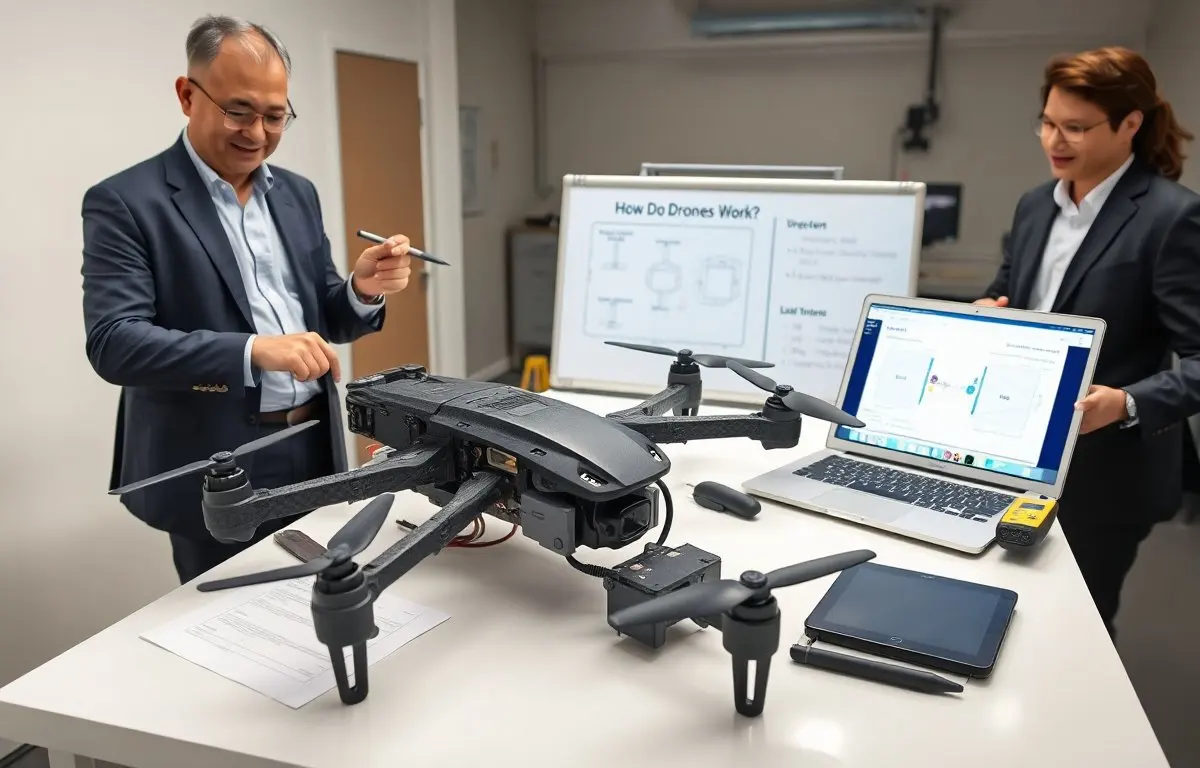
A drone has a frame, motors, propellers, a power source, and a flight controller. The frame holds parts in place. Motors turn the propellers. The battery supplies power to the motors and electronics. The flight controller reads sensor data and sends signals to the motors.
A radio receiver links the drone to a remote controller. The remote sends stick inputs. The receiver passes inputs to the flight controller. The controller translates inputs into motor commands. Electronic speed controllers (ESCs) change motor speed when the controller sends signals.
A drone also has a power distribution board or integrated harness. The board routes battery current to motors and electronics. It keeps voltage stable. A voltage regulator supplies consistent power to the flight controller and sensors.
A camera or payload mounts to the frame when needed. A gimbal stabilizes the camera. The gimbal uses small motors and sensors to keep the camera level. The flight controller can integrate gimbal commands or a separate controller can handle them.
This section answers how do drones work at the component level. Each part plays a clear role. The parts work in a loop: pilot input, controller processing, motor output, and sensor feedback. That loop lets the drone respond to commands and fly as intended.
Flight Mechanics: Lift, Thrust, Stability, And Control
Lift comes from propellers that push air downward. Motors spin the propellers. Faster spin creates more lift. The lift must overcome the drone weight for takeoff.
Thrust moves the drone forward, backward, and sideways. The flight controller changes motor speeds to create differential thrust. The drone tilts to translate lift into horizontal motion. Pilots use throttle, roll, pitch, and yaw inputs to control motion.
Stability depends on sensor data and control loops. The flight controller reads accelerometers and gyroscopes. It runs control algorithms to minimize error. The algorithms adjust motor speeds to hold attitude and altitude. Gyros help the drone resist rotation. Accelerometers measure linear motion.
A multirotor drone uses paired motors to balance torque. Opposing motors spin in opposite directions to cancel yaw torque. The controller adjusts pairs to create yaw when the pilot commands it. Control surfaces matter less for most consumer drones. They rely on motor thrust for steering.
This explains how do drones work in the air. The system converts pilot commands into motor speed changes. The controller uses feedback to keep the drone stable. The result is controlled, smooth flight when systems operate correctly.
Sensors, Navigation, Communication, And Safety Systems
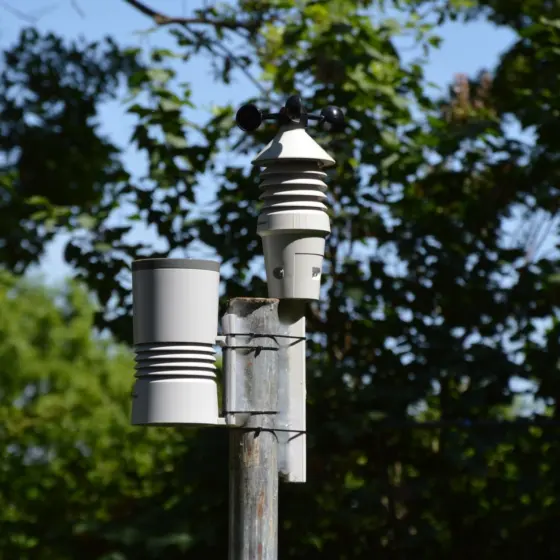
Drones use sensors to sense position and motion. Common sensors include GPS, magnetometer, barometer, accelerometer, and gyroscope. GPS gives global position. The magnetometer gives heading relative to Earth magnetic fields. The barometer gives altitude pressure readings. The controller fuses these inputs to estimate position.
Optical flow and visual sensors help in low GPS areas. Cameras or dedicated sensors compare ground features between frames. The controller uses that data to hold position when GPS is weak. Ultrasonic sensors and lidar provide short-range altitude and obstacle data.
Communication systems send telemetry and video to the pilot. Radio links carry control commands and telemetry. Video downlinks send live camera feed. Modern drones use digital links that reduce interference and increase range. Many systems switch frequencies to avoid congestion.
Safety systems protect the drone and people. Geofencing prevents flight in restricted areas. Return-to-home triggers automatic return on signal loss or low battery. Redundant systems duplicate critical parts like ESCs or GPS on advanced models. The flight controller can force a safe landing if it detects critical failure.
Operators must follow local laws and safety practices. They should preflight-check the battery, props, and GPS lock. They should observe no-fly zones and keep visual line of sight. These steps reduce the chance of accidents and loss.
This section clarifies how do drones work with their sensing and safety features. Sensors provide state data. Navigation systems use that data to guide motion. Communication systems connect pilot and drone. Safety systems act when conditions become unsafe.